Skip to content
United States

Morgan Dollar

United States · 1878-1921 · Silver

Written by the Maison Or & Bijoux Strasbourg team · updated

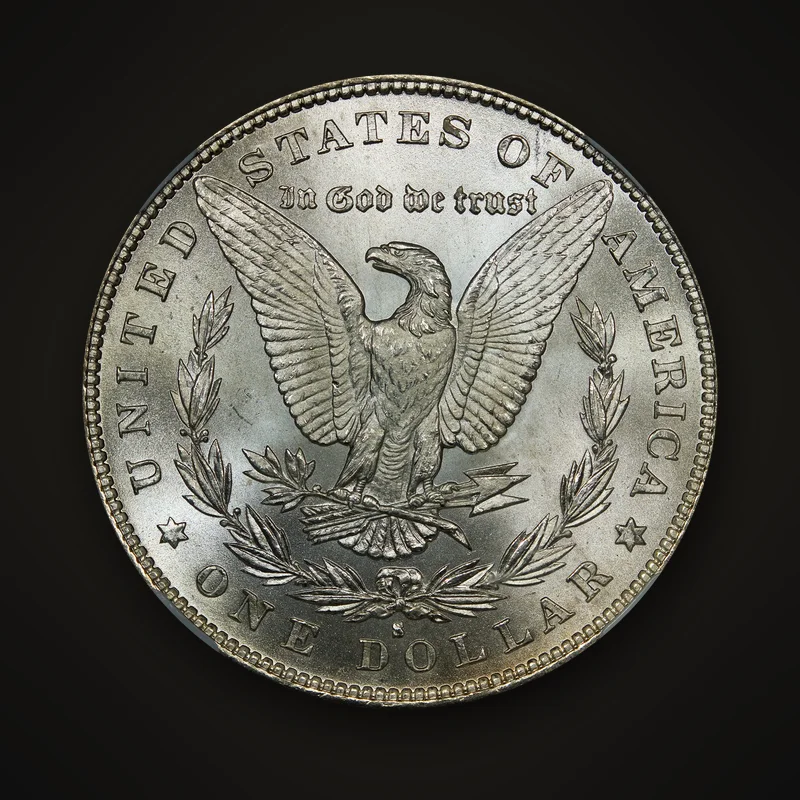
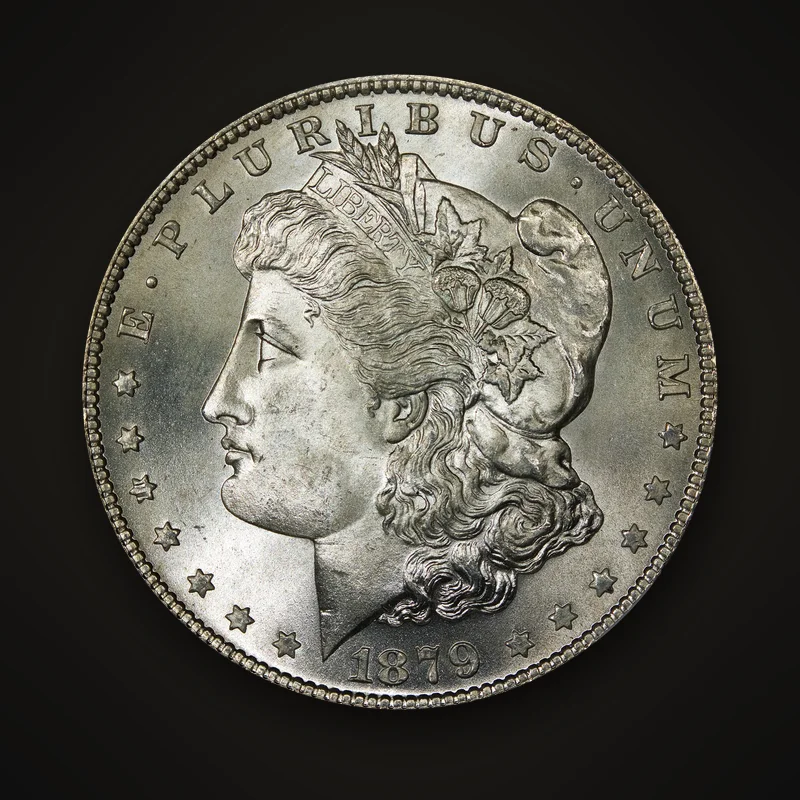
1879 silver Morgan Dollar struck in San Francisco, obverse: head of Liberty wearing a Phrygian cap1879 Morgan Dollar, reverse: eagle with outspread wings within a laurel wreath, S mint mark
Photos: Brandon Grossardt, CC BY-SA 3.0, via Wikimedia Commons, cut out on a black background.
Specifications
CountryUnited States
MetalSilver, 900‰ fine (10% copper)
Weight26.73 g
Fine silver24.057 g
Diameter38.1 mm
Thickness2.4 mm
Years struck1878 to 1904, then 1921 (commemorative issues in 999‰ silver since 2021)
Mintsno letter (Philadelphia), CC (Carson City), O (New Orleans), S (San Francisco), D (Denver, in 1921 only)
EngraverGeorge T. Morgan
EdgeReeded
ReferencesKM# 110

The Morgan Dollar is the large silver one-dollar coin of the United States, struck from 1878 to 1904 and again in 1921. It is recognised by the head of Liberty wearing a cap and by the eagle with open wings on the reverse, on a 38 mm flan. More than 650 million were struck, which explains how often it appears in collections, even in Europe.

Identification

Morgan Dollar: how to recognise it

1879 silver Morgan Dollar struck in San Francisco, obverse: head of Liberty wearing a Phrygian cap

Obverse

Head of Liberty facing left, wearing a Phrygian cap decorated with ears of wheat and cotton bolls; the headband carries the word “LIBERTY”. The motto “E PLURIBUS UNUM” runs along the top, thirteen stars surround the head, the date is at the bottom.

1879 Morgan Dollar, reverse: eagle with outspread wings within a laurel wreath, S mint mark

Reverse

Eagle with outspread wings holding an olive branch and arrows, within a laurel wreath. Legends “UNITED STATES OF AMERICA” and “ONE DOLLAR”, with “IN GOD WE TRUST” in Gothic letters above the eagle. The mint mark, when there is one, is placed below the wreath, above the letters “DO” of “DOLLAR”.

Edge
Reeded.
Engraver
George T. Morgan, assistant engraver at the United States Mint in Philadelphia. His initial “M” appears at the base of Liberty's neck and on the bow of the wreath on the reverse. The profile was modelled on Anna Willess Williams, a young woman from Philadelphia.
Dates and mintages

Morgan Dollar: key dates

A Morgan Dollar is read in two steps: the date on the obverse, then the mint mark on the reverse, below the wreath. The same year can be common at one mint and rare at another. The CC coins from Carson City, struck in small numbers, and the year 1893 account for most of the rarities; 1921, by contrast, is the most frequent date.

Morgan Dollar: dates and mintages
YearMintMintageRemarks
1878no letter10,508,800First year; the eagle goes from eight to seven tail feathers during the striking.
1878CC2,212,000First Carson City Morgan Dollar.
1878S9,774,000Common.
1879CC756,000Sought-after CC date.
1881CC296,000Low mintage; many coins stayed in bags.
1884S3,200,000Common when worn, very rare uncirculated.
1885CC228,000Lowest CC mintage along with 1881.
1889CC350,000The most sought-after CC date.
1892S1,200,000Few uncirculated coins known.
1893no letter378,000Crisis year: every mint struck little.
1893O300,000Rare.
1893CC677,000Last year of Carson City.
1893S100,000Lowest circulation mintage of the series; very often imitated.
1894no letter110,000Rare.
1895no letter880Proofs only: no circulation strike known.
1895O450,000Rare, especially in fine condition.
1895S400,000Rare.
1899no letter330,000Low mintage for Philadelphia.
1901no letter6,962,000Common when worn, rare uncirculated.
1903O4,450,000Long rare, became accessible after Treasury bags were released.
1904S2,304,000Last year before the interruption.
1921no letter44,690,000New dies with flatter relief; the most common date.
1921D20,345,000Only year for Denver.
1921S21,695,000Common.

Mintages from the Wikipedia (en) table, cross-checked for key dates with the PCGS, Numisview and Coinweek guides. The table does not cover all 96 year and mint combinations: it shows the best-known rare dates and a few common reference dates.

Varieties and known fakes

The series has many die varieties, especially in its first year. In 1878, the eagle on the reverse first has eight tail feathers, then seven, and some coins show the seven feathers re-engraved over the eight. In 1921, the dies were entirely remade: the relief is flatter, the details of the hair and feathers less pronounced. Proofs, with mirror fields, also exist for most Philadelphia years.

Fakes are numerous and fall into two families. The first gathers complete copies, often in silvered white metal, which give themselves away by their weight (a genuine coin weighs 26.73 g), their dull ring and sometimes the magnet. The second, more dangerous, starts from a genuine coin that is altered: an S is added to an 1893 Philadelphia coin to imitate the 1893-S, CC is added to a common 1889, or the S is removed from an 1895-S to make an 1895 Philadelphia. Weight and metal are then correct: only examining the mint mark area under a loupe (tool marks, solder, re-polished field) and the shape of the date numerals can settle it. The guide spotting a fake coin (in French) sets out the basic checks.

Not to be confused with

The Peace Dollar (1921-1935) succeeded it: same weight, same metal, but Liberty wears a radiate crown and the reverse shows an eagle perched on a rock, with the word “PEACE”. The Seated Liberty dollar, struck before 1873, shows a seated Liberty. The Trade Dollar (1873-1885), intended for trade with Asia, is slightly heavier and carries the words “TRADE DOLLAR”.

The Morgan Dollars of 2021 and later years, struck for the centenary, take up the design in 999‰ silver: their recent date is enough to tell them apart. Finally, many “Morgan Dollars” sold as souvenirs are replicas with no silver, sometimes marked “COPY” in small letters; a weight well below 26.73 g rules them out at once. For other foreign silver coins, see the section silver coins (in French).

Grading this coin

The Morgan Dollar circulated widely in the American West, but millions also stayed in bags in Treasury vaults: you therefore find both heavily worn coins and coins that never circulated. On the obverse, wear first appears on the hair above the ear and the forehead, then on the cotton leaves and the wheat ears of the cap. On the reverse, look at the eagle's breast, whose feathers fade first, then the top of the wings and the talons.

In uncirculated condition, a coin shows mint lustre that turns with the light, but almost always contact marks caused by coins rubbing against each other in the bags; their number and position on Liberty's cheek count for a lot. Some coins have naturally mirrored fields, known as prooflike. Silver takes on a grey or iridescent toning over time: it is normal and must not be removed. A dollar rubbed with silver polish loses its original lustre permanently, as the guide cleaning a coin explains. The grading scale is set out in the guide coin grades (both in French).

History

The Morgan Dollar was born of a law: the Bland-Allison Act, passed on 28 February 1878 over President Hayes's veto, required the Treasury to buy 2 to 4 million dollars' worth of silver each month to strike into coin. The Nevada mines were then producing in bulk, and the nearby Carson City Mint received its share. Striking began on 11 March 1878. The Sherman Silver Purchase Act of 1890 increased silver purchases further, before its repeal on 1 November 1893, in the middle of a financial crisis: this is why the 1893 and 1894 mintages are so low.

Production stopped in 1904, once the stock of purchased silver was used up. In 1918, the Pittman Act authorised the melting of silver dollars: 270,232,722 coins were melted, most of the silver being sold to the United Kingdom. The same law then required silver to be bought back to replace these coins, which led to the return of the Morgan in 1921, with new dies, before it was replaced by the Peace Dollar the same year.

In the early 1960s, the Treasury found in its vaults just over 2.8 million Carson City dollars that had never been distributed. They were sold to the public by the General Services Administration in seven sales between 1972 and 1980, often in an original black plastic holder. Find other coins of the Americas in the section foreign coins (in French).
In Strasbourg

Morgan Dollar in Alsace

The Morgan Dollar has no historical link with Alsace and never circulated in France as money. It is found in Alsatian collections as elsewhere, often with a Peace Dollar or $20 gold coins. When a family keeps several, noting the date and mint mark of each one quickly sorts the common coins from those that deserve a closer look.

Morgan Dollar: frequently asked questions

Where is the mint mark on a Morgan Dollar?

On the reverse, below the laurel wreath, just above the letters “DO” of “DOLLAR”. With no letter, the coin was struck in Philadelphia.

My dollar has “CC” on it: is it rare?

The CC coins from Carson City were all struck in modest quantities and are sought after. Some years, such as 1889, are rare; others, released from Treasury stocks in the 1970s, are easier to find in uncirculated condition.

Why are there so many 1921 Morgan Dollars?

After the mass melting decided in 1918, the law required dollars to be struck again: more than 86 million Morgans came out of the Philadelphia, Denver and San Francisco mints in 1921.

Should I clean a blackened Morgan Dollar?

No. Silver toning is natural and protects the coin. Cleaning leaves fine scratches and removes the original lustre, which takes away the interest of a collector coin.