Varieties and known fakes
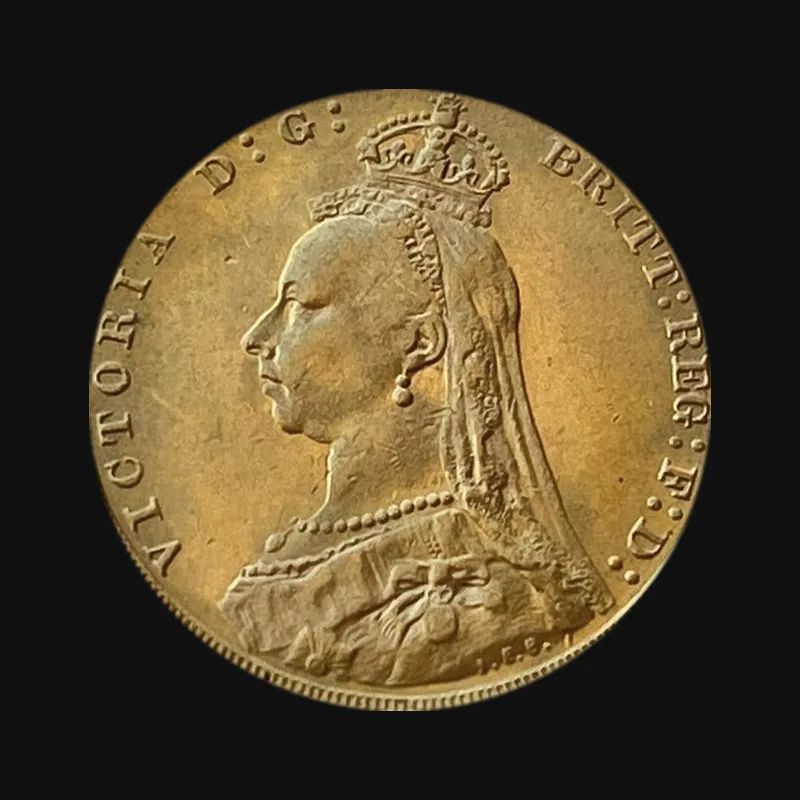
The varieties come first from the portraits: Victoria exists as a young head (1838-1887), a Jubilee head (1887-1893) and a veiled old head (1893-1901). The “Sydney Mint” type sovereign, struck from 1855 to 1870, shows Victoria with a banksia sprig in her hair and carries the name of the mint and “ONE SOVEREIGN” on the reverse. Under Victoria, London and Australia struck the shield reverse and the Saint George in parallel, Australia keeping the shield until 1887. Some 1863 coins carry a small “827” on the obverse, in place of William Wyon's initials according to Wikipedia (en), probably an ingot number.
The sovereign is one of the most imitated gold coins in the world. After the Second World War it still circulated in Greece and the Middle East, where demand was strong, which encouraged clandestine workshops in Syria, Italy, Switzerland and then Lebanon in the early 1970s. Many of these fakes contain the right amount of gold, so scales alone are not enough. The signs to look for are soft relief, the grainy surface of a cast coin, irregular milling and a combination of date, portrait or mint that does not exist. Resuming production in 1957 was precisely meant to compete with these copies. See also the guide spotting a fake coin (in French).
Grading this coin
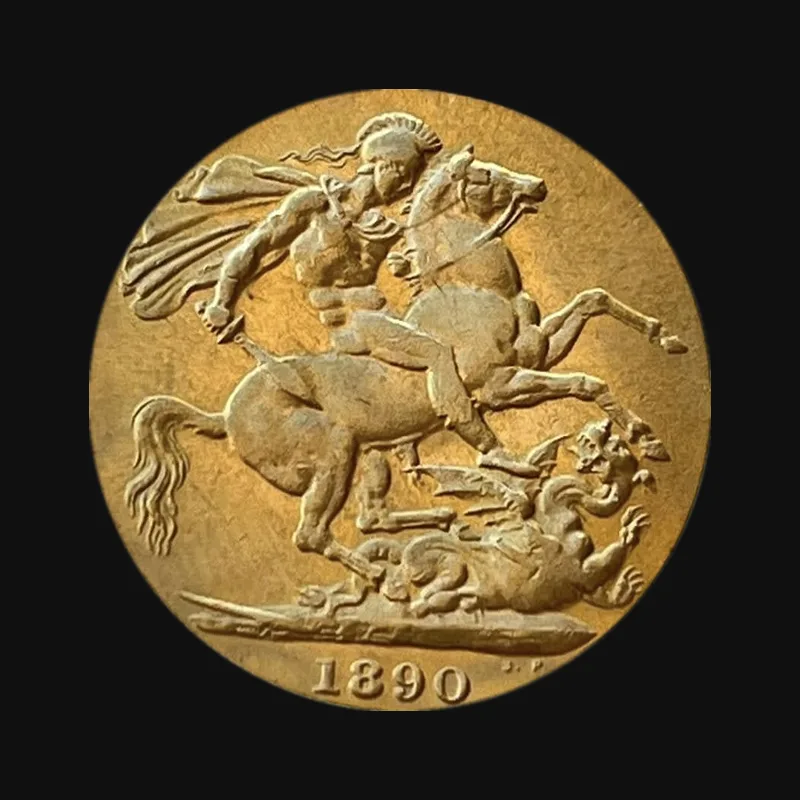
Saint George is the best indicator of wear. Look first at the helmet and the horse's mane, then the rider's thigh and the animal's muscles: on a heavily circulated coin they become a smooth surface. The scales and tail of the dragon also disappear quickly.
On the portrait side, the high points depend on the reign. On George V, the beard and ear; on Edward VII, the cheekbone and the hair above the ear; on the young Victoria, the bun and the locks tied with a ribbon. On the shield reverse, watch the details of the crown and the laurel leaves.
Sovereigns were widely used in payment, then in jewellery: mount marks, edge knocks and cleaning scratches are common. For a common date, these defects matter little. For a rare date, they weigh heavily, which is why you should never clean a coin (guide in French). The grading scale is explained in the guide coin grades (in French).
History
The sovereign was born of the great recoinage of British money that followed the Napoleonic Wars. Authorised by the Coinage Act of 1816, it was struck from 1817 and replaced the guinea as the reference gold coin. Pistrucci, an Italian engraver, designed the Saint George for it, which was dropped in 1825 and then restored in 1871.
The Australian gold rush changed the scale of production. Sydney struck from 1855, first with its own type, then from 1871 with the London type and a mint mark. Melbourne opened in 1872, Perth in 1899, Ottawa in 1908. During the First World War, a temporary mint operated in Bombay from August 1918 to April 1919, all its coins being dated 1918, with South African gold that the naval war prevented from being shipped to London. Pretoria took over from 1923 to 1932.
After 1917, London struck almost no sovereigns for circulation, 1925 being the best-known exception. The Australian mints stopped in 1931, Pretoria in 1932. The coin returned in 1957, struck in large runs until 1968, and again since 1974. The half sovereign follows the same history, with its own dates. You will find other British and Commonwealth coins in the section foreign coins (in French).