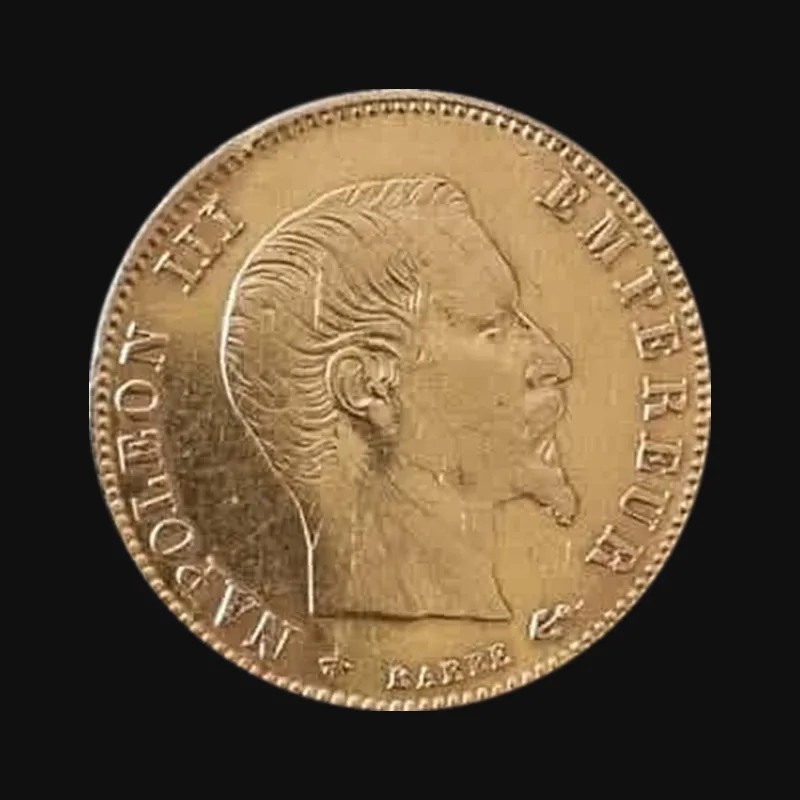
Obverse
The emperor's head facing right, surrounded by the legend “NAPOLEON III EMPEREUR”. Up to 1860 the head is bare; from 1862 it wears a laurel wreath whose ribbon falls onto the nape. The name BARRE is engraved below the neck.
Written by the Maison Or & Bijoux Strasbourg team · updated
| Country | France |
|---|---|
| Metal | Gold, 900‰ |
| Weight | 1.6129 g |
| Fine gold | 1.4516 g |
| Diameter | about 14.4 mm (small module), 16.7 mm (large bare-head module), 17 mm (laureate head) |
| Periods | Small module 1854-1855, large bare-head module 1855-1860, laureate head 1862-1868 |
| Mints | Paris (A) from 1854 to 1868; Strasbourg (BB) from 1858 to 1868 |
| Mintages | About 4.5 million small modules, 24.2 million large bare heads, 18 million laureate heads |
| Catalogues | F.500, F.500A, F.501 and F.502 (Le Franc); KM 787 and KM 803 |
This tiny gold disc weighs only 1.61 g and is no more than 17 mm across. Struck from 1854 to 1868 in close to 47 million pieces, it went through three designs: a small module soon dropped, a large module with the bare head, then the laureate portrait. Strasbourg supplied about a quarter of them, under the letters BB, from 1858 until the end of the type.
The emperor's head facing right, surrounded by the legend “NAPOLEON III EMPEREUR”. Up to 1860 the head is bare; from 1862 it wears a laurel wreath whose ribbon falls onto the nape. The name BARRE is engraved below the neck.
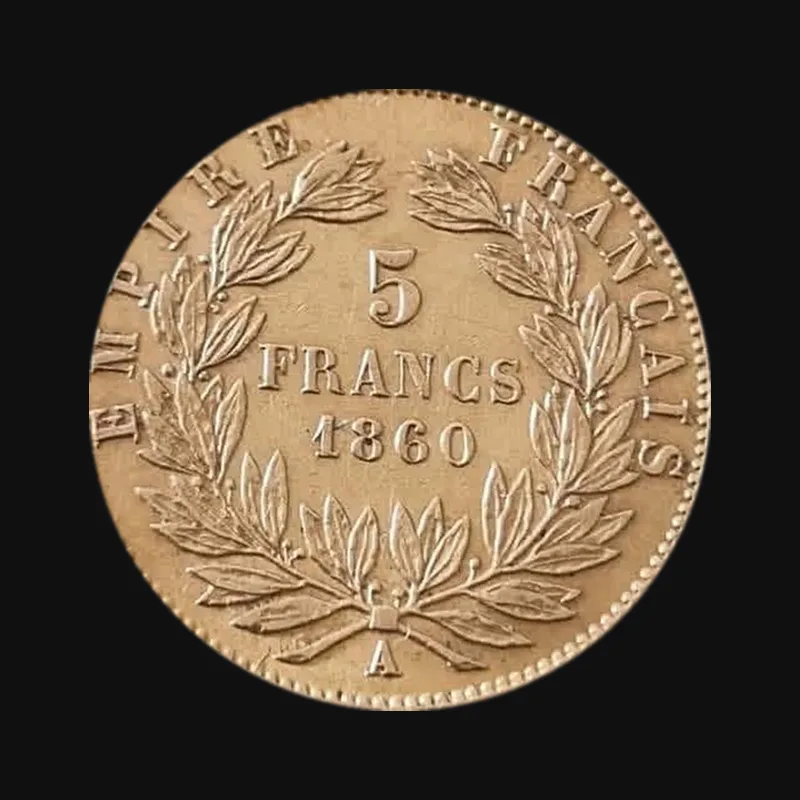
The value “5 FRANCS” in two lines at the centre, the date beneath, all enclosed by two laurel branches joined at the bottom. Around it, “EMPIRE FRANÇAIS”. Under the tie of the branches, the letter A or BB between two privy marks.
One line per year and mint, from the BDOR tables. The letters BB first appear in 1858, on a tiny run; Strasbourg then strikes every year until 1868, except 1861, when no gold 5 francs was made anywhere. On the laureate head, the Alsatian mint even overtakes Paris in 1865 and 1867.
| Year | Mint | Mintage | Note |
|---|---|---|---|
| 1854 | A | 3,562,208 | Small module; plain or reeded edge |
| 1855 | A | 937,732 | Small module, end of the series |
| 1855 | A | 1,352 | Large module, opening year |
| 1856 | A | 2,960,085 | 6 over 5 variety |
| 1857 | A | 3,479,167 | No BB striking |
| 1858 | A | 2,982,985 | |
| 1858 | BB | 31,488 | BB starts, very small run |
| 1859 | A | 5,659,773 | Annual record for the type |
| 1859 | BB | 2,247,999 | |
| 1860 | A | 4,798,130 | 6 over 5; bee variety |
| 1860 | BB | 2,021,675 | 6 over 5 known |
| 1862 | A | 1,100,515 | Laureate head begins |
| 1862 | BB | 882,075 | |
| 1863 | A | 1,590,708 | |
| 1863 | BB | 1,103,564 | |
| 1864 | A | 2,239,561 | Peak of the laureate head |
| 1864 | BB | 899,564 | |
| 1865 | A | 824,020 | Paris behind BB |
| 1865 | BB | 927,585 | Ahead of Paris |
| 1866 | A | 1,948,610 | |
| 1866 | BB | 1,388,489 | |
| 1867 | A | 1,006,173 | |
| 1867 | BB | 1,504,435 | Ahead of Paris |
| 1868 | A | 1,864,491 | End of the type |
| 1868 | BB | 726,994 | Lowest laureate mintage |
Figures from BDOR. Differences found elsewhere: 936,176 for the 1855 A small module at CGB, 1,177,494 for 1862 A at Heritage. Each line adds up any varieties, which are described after Le Franc.
The first gold 5 francs, authorised by a decree of 12 January 1854, is disconcertingly small: about 14.4 mm. The very first pieces left the press with a plain edge, until a decree of July 1854 called for reeding. Judged too small, the format was soon abandoned: in July 1855, 888,000 coins went to the melting pot on a ministerial decision, and demonetisation followed in 1859.
The large module took over in 1855. The weight stays the same, spread over a wider, thinner 16.7 mm flan. Paris produced only 1,352 in its first year, before moving to several million a year.
The laureate head appeared in 1862, at 17 mm. The reverse stayed put: where the 20 francs laureate head adopted the imperial arms, the 5 francs kept its laurel wreath. The portrait is therefore what classifies a coin.
The mint mark is read on the reverse, under the knot of the branches: A for Paris, BB for Strasbourg. No other letter exists on this type. If you can make out only one B, one of the two letters has probably worn away.
Two small symbols frame the letter: these are privy marks, the signs of Mint officials. The bee belongs to Alfred Renouard de Bussière, who ran the Strasbourg mint from 1834 to 1860 before taking charge of the Paris Mint; BDOR does record an 1860 A variety with the bee.
Date varieties call for a loupe: a 6 cut over a 5 is known on 1856 A, 1860 A and 1860 BB. The catalogues also cite a few patterns (1855, 1862) and burnished flans dated 1854, kept in major collections.
The main risk comes from the gold 10 francs of Napoleon III (page in French): its first module, in 1854 and 1855, measures 17 mm, as much as a laureate 5 francs. Only the figure inside the wreath and the scales decide: 1.61 g on one side, about 3.22 g on the other.
The small silver coins of the reign carry the same profile. The 50 centimes, 18 mm and 2.5 g, is known by its white colour and its value “50 C”. As for the silver 5 francs crown, its 37 mm and 25 g rule out any mistake.
One last case: the Third Republic struck a gold 5 francs of the Ceres type between 1878 and 1889, with no imperial portrait at all.
On so small a flan, examination means a 10× loupe under raking light. The first areas to flatten are the hair above the ear and the cheekbone on the bare head, and the leaves of the wreath on the laureate head. On the reverse, follow the vein of each laurel leaf, then the knot and the privy marks. Grades are described in the guide to conservation grades (in French).
Many of these coins were set as pendants or cufflinks. A trace of solder on the edge, crushed reeding, a plugged hole or a polished patch betray a former mount and put collectors off.
If a copy is suspected, check the weight, the diameter specific to the type, the regularity of the reeding and the sharpness of the signature. A gilt brass imitation is too light for its size. Avoid any cleaning: the cleaning guide explains why, and the one on fake coins sets out other tests (both in French).
Californian, then Australian gold poured into France in the early 1850s. The government used it to extend the range of gold coins downwards: after the Ceres 10 francs of 1850, the gold 5 francs was born in 1854, the very year of the 10 francs with the imperial effigy. It offered a light alternative to the silver crown of the same value.
The monetary convention of 1865, which founded the Latin Union with Belgium, Italy and Switzerland, listed the gold 5 francs among the shared denominations. French striking nonetheless stopped as early as 1868. They stayed in circulation until the Great War; their official withdrawal came in 1928.
Strasbourg struck the gold 5 francs only from 1858, and cautiously at first: 31,488 pieces that year, against nearly 3 million in Paris. The 1858 BB, rated R2 by CGB, thus has the lowest mintage of the large module after the 1855 Paris coin. The BB mint then gathered pace, with over 2 million pieces in both 1859 and 1860, and struck the laureate head every year from 1862 to 1868. Over that second period it supplied about 41% of output and beat Paris in 1865 and 1867. All told, slightly more than one gold 5 francs in four carries the letters BB. The history of the mint is told on the Strasbourg coins page.
1858, 1859 and 1860 for the bare head, then every year from 1862 to 1868 for the laureate head. There is no BB gold 5 francs before 1858 and no Strasbourg small module.
It is the last type, struck from 1862 to 1868 at 17 mm. Its reverse repeats that of the bare head; only the portrait changes.
It keeps its gold, but the marks of the mount make it unappealing to a collector. A numismatist can look at it during a free appraisal.
They are privy marks, the signs of Mint officials. The bee, for instance, stands for Alfred Renouard de Bussière, director in Strasbourg and then in Paris.