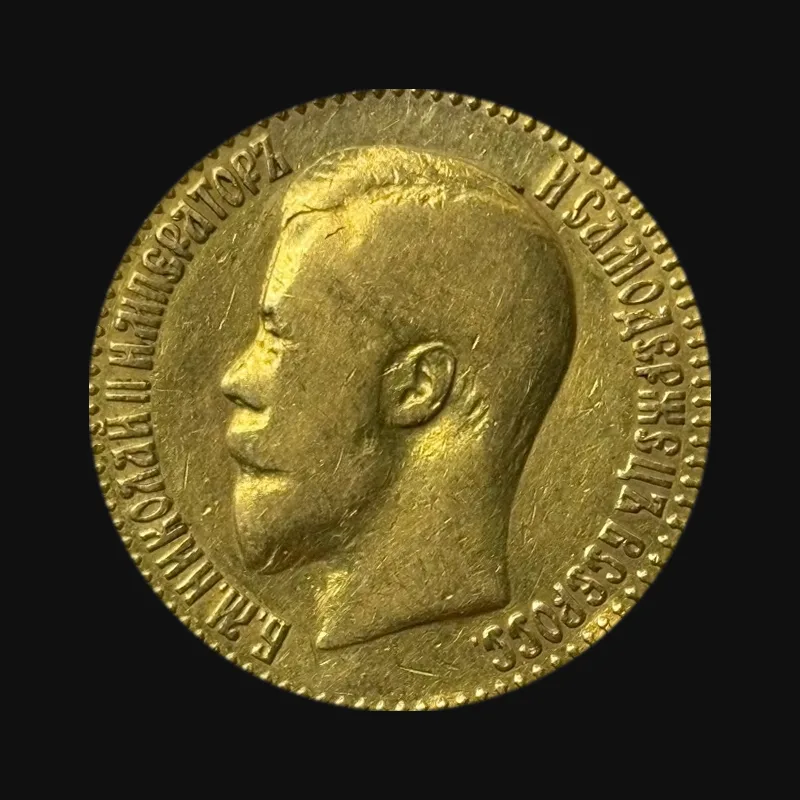
Obverse
Bare head of Nicholas II facing left, with the legend “Б.М. НИКОЛАЙ II ИМПЕРАТОРЪ И САМОДЕРЖЕЦЪ ВСЕРОСС.” (By the grace of God, Nicholas II, Emperor and Autocrat of All Russia). All four denominations share this legend.
Written by the Maison Or & Bijoux Strasbourg team · updated
| Country | Russia |
|---|---|
| Metal | Gold, 900‰ fine |
| Weight | 10 roubles: 8.60 g; 7.50 roubles: 6.45 g; 15 roubles: 12.90 g; 5 roubles: 4.30 g |
| Fine gold | 10 roubles: 7.74 g; 7.50 roubles: 5.81 g; 15 roubles: 11.61 g; 5 roubles: 3.87 g |
| Diameter | 10 roubles: 22.5 mm; 7.50 roubles: 21.3 mm; 15 roubles: 24.5 mm; 5 roubles: 18.5 mm |
| Years struck | 15 and 7.50 roubles: 1897 only; 10 roubles: 1898 to 1911; 5 roubles: 1897 to 1911 |
| Mint | Saint Petersburg (no mint letter; mintmaster's initials on the edge) |
In 1897 Russia moved to the gold standard and cut the value of its rouble by about a third. For that one year, the old gold pieces were struck under new denominations, 15 roubles and 7 roubles 50 kopecks; the 10 and 5 roubles then carried on until 1911. Every one of them shows the bare head of Nicholas II and the double-headed eagle, so the denomination on the reverse, the weight and the diameter are what tell them apart.
Bare head of Nicholas II facing left, with the legend “Б.М. НИКОЛАЙ II ИМПЕРАТОРЪ И САМОДЕРЖЕЦЪ ВСЕРОСС.” (By the grace of God, Nicholas II, Emperor and Autocrat of All Russia). All four denominations share this legend.
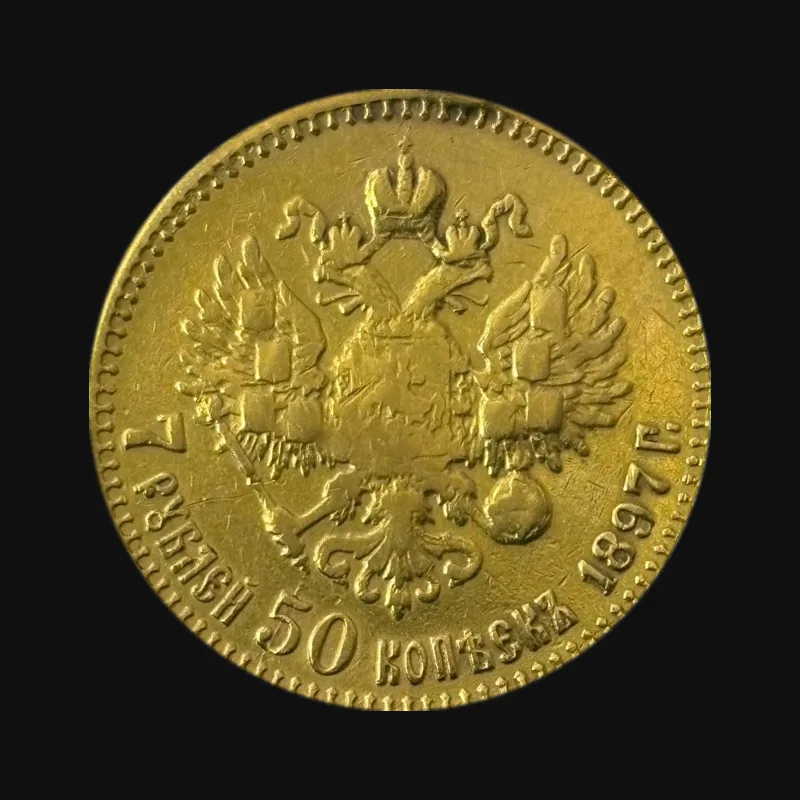
Crowned double-headed eagle, the arms of the Empire, with the value spelled out and the year: “10 РУБЛЕЙ 1899 Г.” on a 10 roubles, “7 РУБЛЕЙ 50 КОПѢЕКЪ 1897 Г.” on a 7.50 roubles, “15 РУБЛЕЙ 1897 Г.” on a 15 roubles.
Read the denomination on the reverse first, then note the year and the initials on the edge. The 1899 to 1904 ten-rouble pieces are common, 1899 alone accounting for more than twenty million coins; the opening year, 1898, and the closing years, 1909 to 1911, were struck in tens or hundreds of thousands only.
| Year | Denomination | Initials | Mintage | Remarks |
|---|---|---|---|---|
| 1897 | 15 roubles | АГ | 11,900,033 | One-year type; same weight as the French 40 francs. Small-head and large-head varieties. |
| 1897 | 7 roubles 50 kopecks | АГ | 16,829,000 | One-year type; same weight as the 20 francs. |
| 1897 | 5 roubles | АГ | 5,372,000 | Common date. |
| 1898 | 10 roubles | АГ | 200,000 | First year of the 10 roubles, far scarcer than 1899. |
| 1899 | 10 roubles | АГ, ФЗ, ЭБ | 27,600,000 (all three mintmasters) | The most common date of the series. |
| 1900-1901 | 10 roubles | ФЗ, АР | unknown | Common. |
| 1902-1904 | 10 roubles | АР | unknown | Common. |
| 1906 | 10 roubles | АР | 10 | Proof strike, an extreme rarity. |
| 1909 | 10 roubles | ЭБ | 50,000 | Rare date. |
| 1910 | 10 roubles | ЭБ | 100,000 | Rare date. |
| 1911 | 10 roubles | ЭБ | 50,000 | Last year of imperial gold. |
Mintages from CGB (15 and 7.50 roubles), CoinVarieties (1897 to 1911) and Updown (1906). Sources disagree on some years, notably 1899, for which CGB gives 23,900,013 coins. The table does not list every date and initials combination of the 5 roubles.
The same design appears on all four coins, which easily misleads. Start with the value written under the eagle: “15 РУБЛЕЙ”, “10 РУБЛЕЙ”, “7 РУБЛЕЙ 50 КОПѢЕКЪ” or “5 РУБЛЕЙ”. Only the 7.50 carries the word КОПѢЕКЪ (kopecks).
Without scales, a ruler often settles it: a 7.50 is the size of a Latin Union 20 francs (in French), a 15 roubles that of a 40 francs gold coin (in French). One catalogue trap: a 10 roubles dated 1897 weighing 12.90 g is not a reform coin but an imperial of the old system, struck in tiny numbers.
As finance minister, Sergei Witte prepared Russia's switch to the gold standard from 1895. The decree of 3 January 1897 set the rule: the new rouble was worth two thirds of the old gold rouble, or 0.774 g of fine gold. The imperials and half imperials, previously worth 10 and 5 roubles, kept their weight but took new values, 15 and 7.50 roubles, matching the French 40 and 20 francs.
Those two values lasted a single year. A decree of November 1897 introduced a 5 roubles with 3.87 g of fine gold, then a decree of December 1898 a 10 roubles with 7.74 g. The Monetary Regulations of 1899 brought all the reform texts together. In 1897 the State Bank's gold reserve passed one billion roubles, enough to make banknotes freely exchangeable for gold.
Gold striking ended in 1911. During the First World War, convertibility was dropped and gold left circulation. Auction catalogues also report 10 roubles struck in 1925 and 1926 by the Soviet authorities from old dies, mostly dated 1911; these are hard to tell from the originals.
Russian gold coins have been widely counterfeited, the 10 and 5 roubles above all. Check the weight and diameter first, then the edge: the incuse lettering should be even and the initials must fit the year (АГ in 1897 and 1898, ЭБ from 1909 to 1911). Soft relief, a grainy field or blurred letters are warning signs. The guide spotting a fake coin (in French) explains these checks.
For wear, look at the beard and the hair above Nicholas II's ear, then on the reverse at the wing feathers and the small regional shields around the eagle. Many coins were worn as jewellery: solder marks, a removed loop, or a filed edge that erases part of the lettering. The usual grading scale (in French) applies, and a gold coin should never be cleaned (see cleaning a coin, in French).
In 1897 Strasbourg belonged to the German Empire, so the Witte reform coins did not reach the city through the ties France then had with Russia. They nonetheless turn up in Alsatian estates and collections, as elsewhere in France, often kept alongside 20 marks (in French) and napoleons. The 7 roubles 50, which weighs the same as a 20 francs, is the one most often mistaken for something else: reading its value on the reverse clears up any doubt.
A 7 roubles 50 kopecks, struck in Saint Petersburg in 1897 only, at the time of the Witte reform. It holds 5.81 g of fine gold, like a 20 francs Napoleon.
Not under the reform standard: the 10 roubles with 7.74 g of fine gold begins in 1898. A 10 roubles dated 1897 and weighing 12.90 g is an imperial of the old standard, struck in very small numbers.
On the edge, at the end of the lettering that states the fine gold weight. They are those of the Saint Petersburg mintmaster, such as АГ, ФЗ, АР or ЭБ.
1906, 1909, 1910 and 1911, all struck in very small numbers, plus the first year, 1898. The 1899 to 1904 dates are common. A free valuation will confirm the date, the initials and the grade.