Coronet or feathers: recognising the type
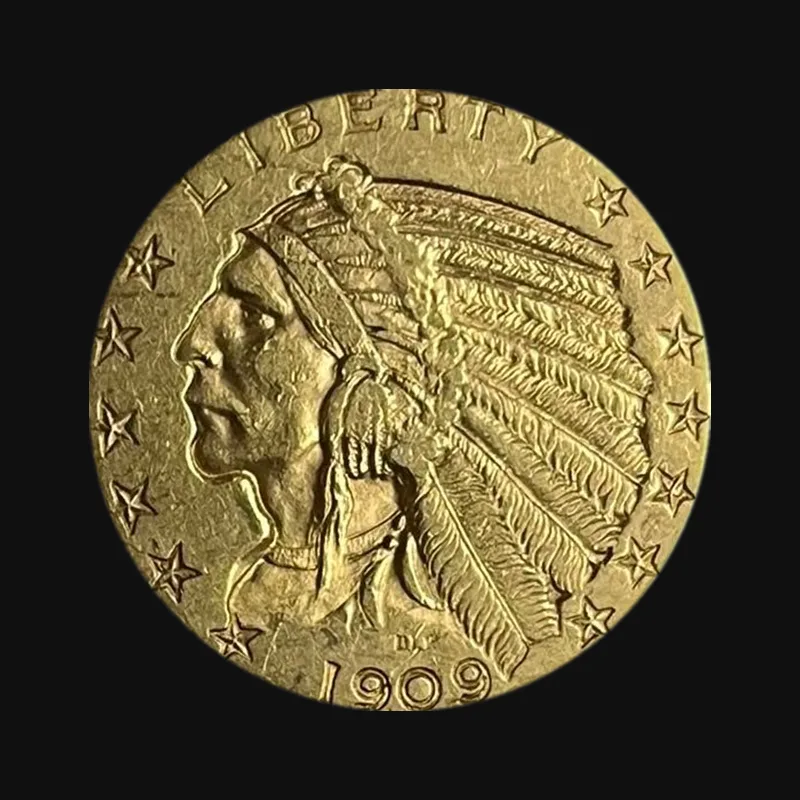
No point checking the edge: it is reeded either way. The face is enough. Gobrecht's Liberty wears a coronet and a bun, in ordinary raised relief; Pratt's Native American, in a feathered headdress, is instead sunk into the blank, so the smooth field is the highest part of the coin.
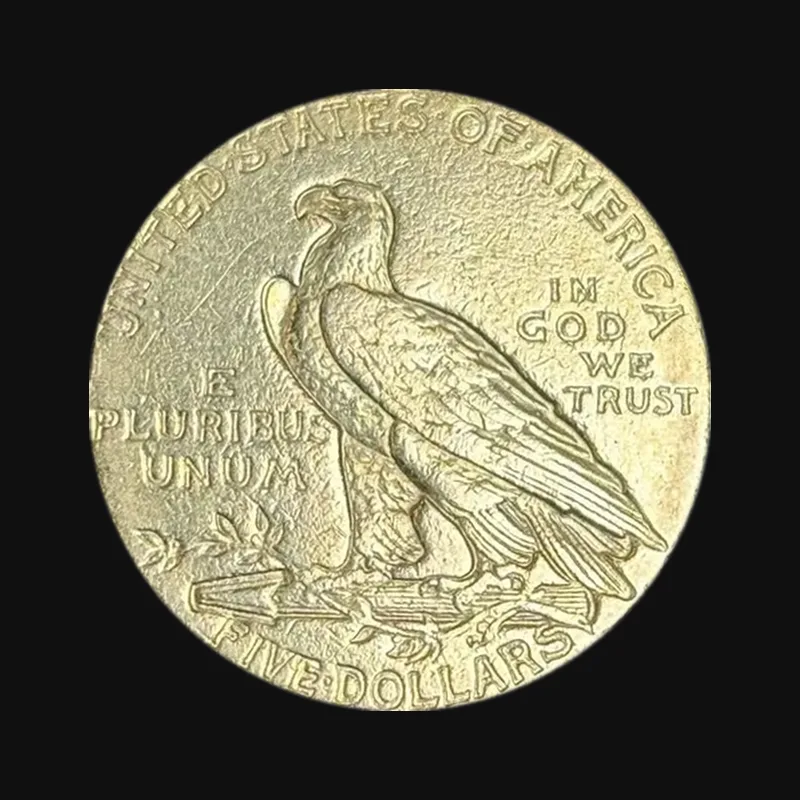
On the reverse, the Coronet's open-winged eagle contrasts with the Indian Head's resting eagle, perched on a bundle of arrows. The value helps as well: “FIVE D.” on the first, “FIVE DOLLARS” spelled out on the second.
Finally, a Coronet without IN GOD WE TRUST predates 1866. The Indian Head always carries the motto.
An incuse design questioned from 1908
The idea came from William Sturgis Bigelow, a Boston physician and friend of Theodore Roosevelt, who had noticed this sunken relief on Egyptian carvings at the Boston Museum of Fine Arts. He suggested to the president that Bela Lyon Pratt be given the design. The coins came out towards the end of 1908 and took people by surprise.
In December 1908 the Philadelphia numismatist Samuel Chapman wrote to Roosevelt that the recesses would hold dirt and germs, that the coins would stack badly and be easy to counterfeit, and that the Indian looked emaciated. Bigelow replied that the portrait came from a recent photograph of a man in excellent health.
The principle matters for wear: on the Indian Head it is the flat surfaces of the field that rub first, not the portrait.
Checks and reported fakes
NGC ranks the $2.50 and $5 Indian Heads among the hardest series to authenticate. It receives large numbers of fakes struck from one shared “stock” reverse die, dated 1909, 1913, 1915 or 1916 with an S mint mark: on these copies the S has stretched ends and blurred serifs, whereas the genuine letter has bulbous, almost square serifs. NGC also examined a supposed 1919, in fact a 1913 whose last digit had been reworked; the sunken date makes this kind of tampering easier.
At home, a few simple steps already weed out crude copies:
- Scales reading to a hundredth: about 8.36 g, a little less for a heavily worn coin.
- Caliper: 21.6 mm (22.5 mm for 1839).
- Magnet: gold is not attracted; a coin that sticks is fake.
- Impossible dates: no Indian Head was struck between 1917 and 1928 or after 1929.
- Mismatched letters: O on an Indian Head other than 1909, CC after 1893, C after 1861.
The right weight proves nothing by itself. The full method is set out in the guide how to spot a fake coin.
$2.50, $5 or $10: let the ruler decide
Pratt drew the same Indian for two denominations, and Gobrecht's Liberty appeared on several coins. Size removes any doubt:
- quarter eagle ($2.50): 18 mm, 4.18 g;
- half eagle ($5): 21.6 mm, 8.359 g;
- eagle ($10): about 27 mm, 16.718 g.
The $5 Coronet has one distinction: according to Wikipedia, it is the only American coin of a single design to have come from seven mints. Its bigger sibling has its own page, the $10 gold coin, as does the $20 gold coin. For the grading scale, see the guide grades of preservation; and never rub a coin, as cleaning a coin explains.