Before Gobrecht: four designs in forty years
The Coinage Act of 1792 provided for the coin, but the first striking dates from 1796: a capped bust facing right, by Robert Scot, heavier (4.37 g) and wider (20.6 mm) than the coins covered here. Fewer than 20,000 pieces left the mint by 1807. John Reich turned the bust to the left in 1808, for a single year. Then came the capped head from 1821 to 1834, followed by William Kneass's Classic Head from 1834 to 1839, whose reverse lacks “E PLURIBUS UNUM”.
The Act of 1834 cut the weight to 4.18 g; the fineness settled at 900 in 1837. These early types are scarce, largely because so many were melted: of some 25,000 capped heads struck between 1829 and 1834, only 400 to 500 are thought to survive.
Liberty Head: sixty-eight years without the motto
Gobrecht's design stayed in use from 1840 to 1907, a record run for the denomination. The $5, $10 and $20 coins in the same style took on “IN GOD WE TRUST” after the Civil War; the quarter eagle never did. A $2.50 Liberty bearing that motto does not exist.
Five mints struck this type. The C, D and O letters vanish before the Civil War; San Francisco stops in 1879, leaving Philadelphia to carry on alone. Carson City never struck a quarter eagle: a CC on a coin this size gives away a fake.
One special case is the 1848 CAL.: California's military governor, Colonel R. B. Mason, sent about 230 ounces of gold-rush gold to the Secretary of War; the metal became 1,389 quarter eagles, punched “CAL.” above the eagle.
The Indian Head, cut below the surface
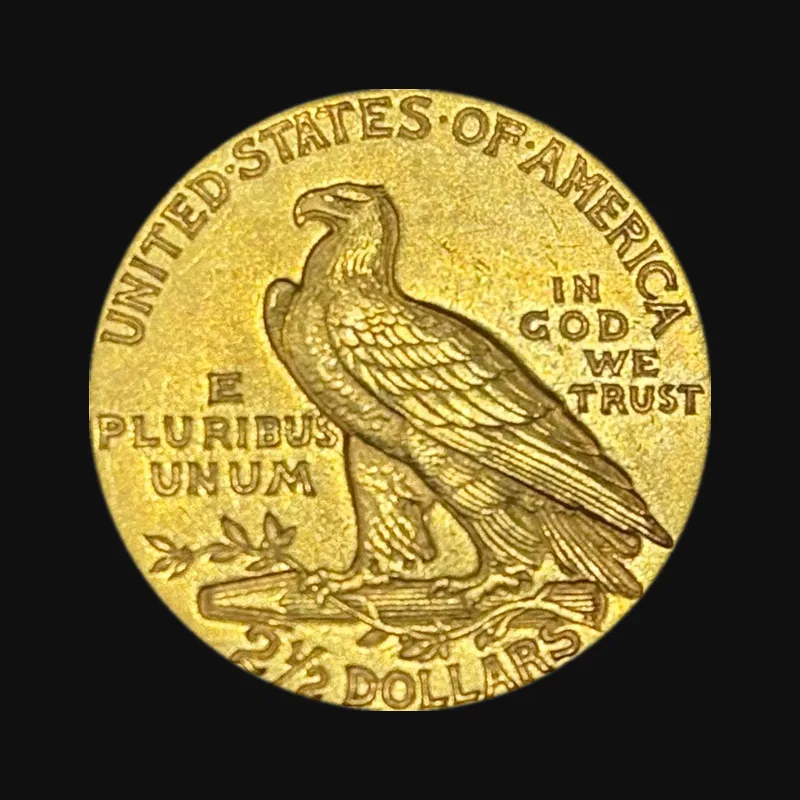
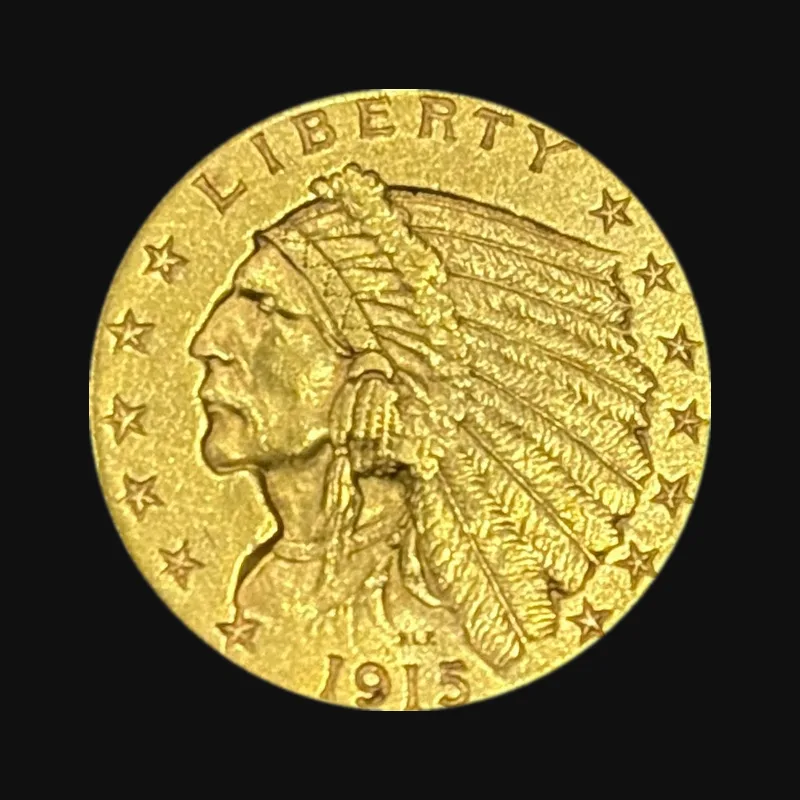
For the small denomination Pratt reused the half eagle design unchanged. Portrait and eagle are sunk in, so the flat field is the highest point of the coin and takes the knocks. According to Collectors Key, that field picks up bag marks easily, which makes high-grade pieces hard to find.
Production had its troubles: the blanks had to be shaved slightly to strike well, and the coins, thinner than their predecessors, upset sorting machines. The series has fifteen date and mint combinations, only three of them from Denver. Halted after 1915 amid the economic conditions of the First World War, it resumed in 1925, mainly to supply coins to give at Christmas, and ended in 1929. Franklin Roosevelt's measures of 1933 closed the denomination for good.
The 1911-D and other traps
With 55,680 pieces, the 1911-D is the key to the Indian Head series, and forgers know it. NGC examined a Philadelphia 1911, a common date struck in more than 700,000 pieces, on which a D had been carved with a tool: the letter was too thick, its serifs badly proportioned, and a loupe showed tool marks around it. Another fake 1911-D had been made by altering the date of a 1914-D. A word of caution, though: on many genuine 1911-D coins the D is weak and blends into the field.
NGC notes a paradox: the very common 1911 without a mint mark is counterfeited more often than the 1911-D, probably because its copies go unnoticed. First checks to make:
- scales: 4.18 g, a little less if wear is heavy;
- diameter: 18 mm;
- magnet: no pull on gold;
- dates: no Indian Head dated 1916 to 1924, no Indian Head marked O or S;
- motto: never IN GOD WE TRUST on a Liberty Head.
These steps do not replace a look under magnification; the whole approach is in the guide how to spot a fake coin. The larger coin of the same design has its own page, the $5 gold coin.