Reading the tughra and working out the date
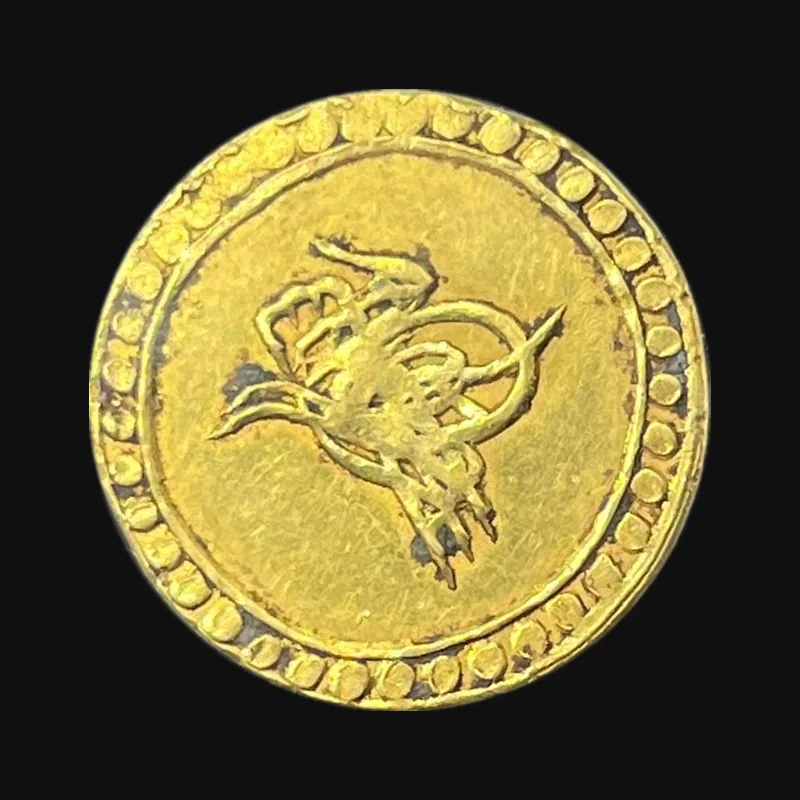
The tughra is the sultan's monogram: his name, his father's name and the phrase « ever victorious », interlaced in calligraphy. Each ruler had his own, and it has appeared on coins since the early 15th century. More than any other detail, it tells you whose coin you hold.
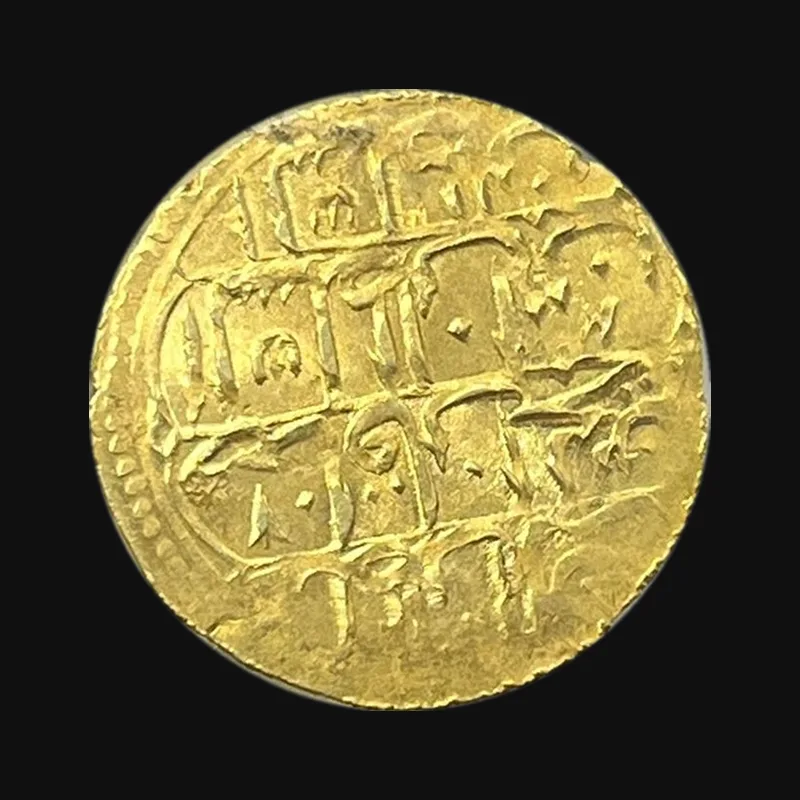
Dating works in two steps. The reverse gives the accession year in the Hijri era; the obverse, below the tughra, gives the regnal year. Add the two and subtract one, since the first regnal year is numbered 1. An Abdülhamid II coin dated 1293, year 23, was therefore struck in 1315 AH, i.e. 1897-1898. A Mehmed V piece marked 1327, year 9, corresponds to 1335 AH, i.e. 1916-1917.
The system misleads many owners: « 1255 » or « 1293 » is not the year of striking, and it stays the same throughout the reign.
Findik, zeri mahbub and small fractions
The first Ottoman gold coin, the sultani or altın, was struck in 1477-1478 under Mehmed II on the Venetian ducat standard, at about 3.45 g. In the early 18th century it gave way to the findik, one dirhem (3.4575 g) at 23 carats, whose name is said to come from the beaded rim, likened to hazelnuts.
The zeri mahbub, « beloved gold », is lighter: half a miskal, or 2.60 g, for 18 mm in the 1716 Istanbul type. According to the TDV Encyclopaedia of Islam, its fineness then fell in stages, to 952‰ under Mahmud I and 800‰ under Mahmud II. Halves and quarters exist: a quarter zeri mahbub of Selim III weighs 0.5 to 0.6 g. The quarter findik was called rubiye, from an Arabic word meaning « quarter ». Both the findik and the zeri mahbub were withdrawn in 1844.
Names of the small denominations shift a great deal under Selim III and Mahmud II, and catalogues also use rumi, adli or hayriye altın. An old name written on a certificate should therefore be checked against weight and diameter. Cairo, for its part, struck a 5 qirsh (piastre) gold coin under Abdülmecid weighing 0.427 g at 875‰, among the smallest of the series.
1844: gold counted in kurush
Abdülmecid's currency reform, decided in 1840, came into force in 1844, with the first mecidiye struck on 22 April that year. Gold was now counted in kurush (piastres), in five values: 25, 50, 100, 250 and 500 kurush. The 100 kurush, or lira, weighs 2 dirhem and 4 kırat, i.e. 7.216 g of 22-carat gold, for 22 mm; the 500 kurush reaches 36.08 g.
More than fifteen million gold pieces were struck between 1844 and Abdülmecid's death, with a steady design of tughra, stars and laurel branches. His successors, from Abdülaziz to Mehmed VI, kept this standard until the end of the Empire. The lira remained bimetallic until 1881, after which the Empire was on the gold standard until the First World War.
De luxe coins and Turkish restrikes
Alongside circulation coins, Istanbul struck de luxe coins (monnaies de luxe): the same value on a broader, thinner flan. Under Abdülhamid II the de luxe 100 kurush weighs 7.01 g against 7.216 g for the regular piece. Made to be worn, nearly all of them are now holed or soldered to a loop.
Republican Turkey kept this dual tradition. The Darphane, the Istanbul mint, still produces 22-carat gold coins in two families: « sikke », smaller and thicker (7.216 g for the unit, known as the Ata lira, with Atatürk's portrait and the date 1923 above the anniversary number of the Republic), and « ziynet », broader and more ornate (7.016 g). It also makes the « Reşat », a type with Mehmed V's tughra that always bears the date 1327 and no year of striking. A coin dated 1327 may thus be Ottoman or very recent.
Checks before drawing conclusions
Weigh and measure first: the gaps between zeri mahbub, findik and kurush show clearly on a scale. Then compare the tughra with reference examples and note the mint name, which separates Istanbul from Misr.
A hole, a loop or a solder mark means the coin was used as jewellery, which is very common here. The gold remains, but collector interest drops. See the guides on spotting a fake coin and coin grades, and the foreign coins section.