Skip to content
United States

The American $10 gold coin (eagle)

United States · 1838-1933 · Gold

Written by the Maison Or & Bijoux Strasbourg team · updated

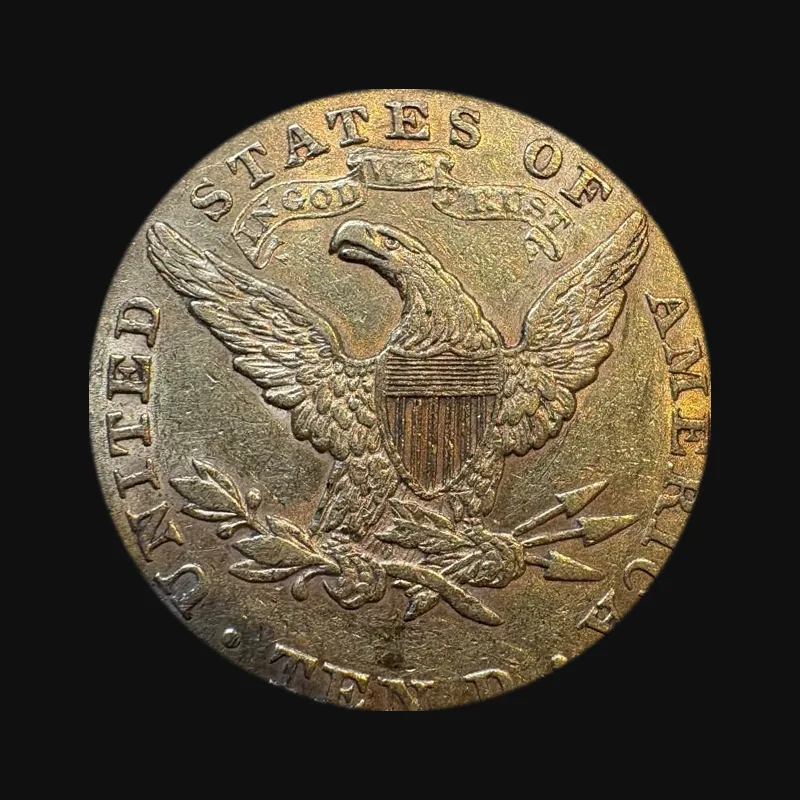
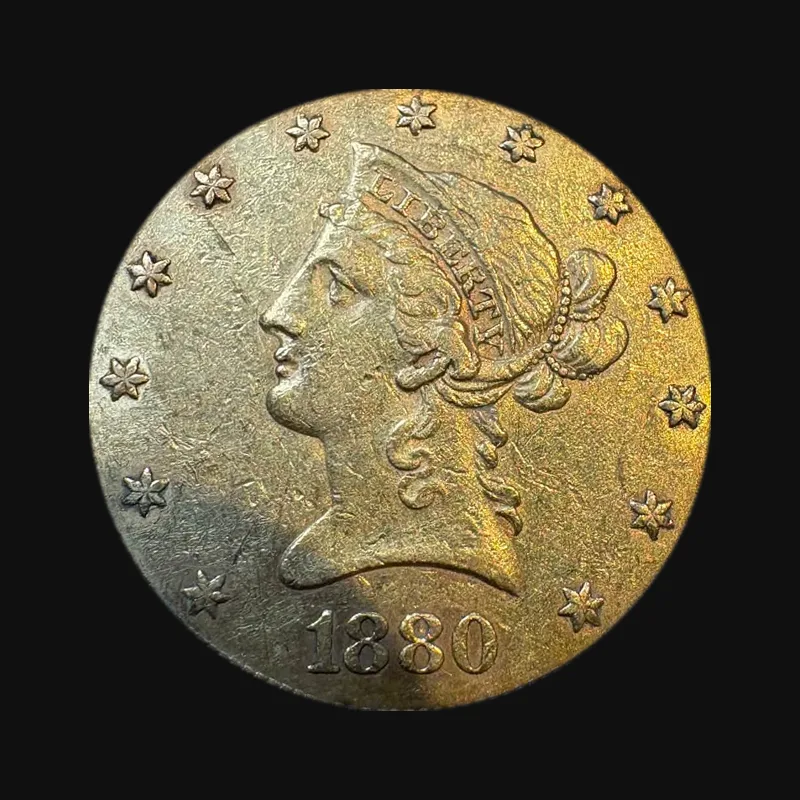
$10 Liberty Head gold eagle dated 1880, obverse with Liberty surrounded by thirteen stars$10 Liberty Head gold eagle, reverse with eagle holding arrows and olive branch, motto IN GOD WE TRUST
Photos: Maison Or & Bijoux.
Specifications
CountryUnited States
MetalGold at 900‰ fineness, alloyed with 10% copper
Weight16.718 g
Fine gold15.046 g
DiameterClose to 27 mm: 26.8 or 27 mm for Gobrecht's type depending on the source, 26.92 mm for Saint-Gaudens's according to Wikipedia
Denomination10 dollars, known as the eagle
Years struckLiberty: 1838-1907; Indian: 1907-1933 (both types were struck in 1907)
MintsPhiladelphia (unmarked), New Orleans (O), San Francisco (S), Carson City (CC), Denver (D); only Philadelphia, Denver and San Francisco struck the Indian type
EngraversChristian Gobrecht (Liberty); Augustus Saint-Gaudens (Indian)
EdgeLiberty reeded; Indian decorated with stars

Struck in 900 fine gold and weighing 16.718 g, the American $10 coin goes by the name of eagle. Two designs make up most of what you will see. From 1838 to 1907 Christian Gobrecht engraved a Liberty wearing a coronet; from 1907 to 1933 Augustus Saint-Gaudens replaced her with a Liberty in a feathered headdress. The size stays close to 27 mm from one type to the other, so the way to separate them is the design, the edge and where the mint mark sits.

Identification

The American $10 gold coin (eagle): how to recognise it

$10 Liberty Head gold eagle dated 1880, obverse with Liberty surrounded by thirteen stars

Obverse

Gobrecht (1838-1907): Liberty looks to the left; a coronet inscribed “LIBERTY” holds her hair, gathered in a bun. Thirteen stars run around the portrait and the date is at the bottom. Saint-Gaudens (1907-1933): same direction, but the head is covered by a feathered headdress reading “LIBERTY”, beneath an arc of thirteen stars.

$10 Liberty Head gold eagle, reverse with eagle holding arrows and olive branch, motto IN GOD WE TRUST

Reverse

Gobrecht: an eagle with open wings grips arrows and an olive branch; the legend “UNITED STATES OF AMERICA” frames it and “TEN D.” reads below. From 1866 a scroll bearing “IN GOD WE TRUST” is added above its head. Look for the mint mark between the eagle and “TEN D.”. Saint-Gaudens: the eagle stands upright on arrows tied in a bundle, with an olive branch. Coins of 1907 and the first ones of 1908 carry no motto; it then takes its place in the left field, level with the bird's breast. The mint mark is on the left of the bundle.

Edge
Reeding on Gobrecht's design. Raised stars on Saint-Gaudens's: there are 46 between 1907 and 1911, and 48 from 1912.
Engraver
Christian Gobrecht, the US Mint's third Chief Engraver, created the coronet type. The feathered headdress type is by the sculptor Augustus Saint-Gaudens, who died in August 1907 before it was issued; Charles Barber inserted the motto in 1908.
Dates and mintages

The American $10 gold coin (eagle): key dates

Two details are enough to classify an eagle: its date and its mint mark. The Liberty-type reverse places the mark between the eagle and “TEN D.”; the Indian-type reverse puts it beside the bundle of arrows, on the left. Without a letter, the mint is Philadelphia. The rows below are selected landmarks, not a full inventory of dates.

The American $10 gold coin (eagle): dates and mintages
YearTypeMintMintageRemarks
1838LibertyPhiladelphiaunknownReturn of the eagle, halted since 1804.
1839LibertyPhiladelphiaunknownNew rendering of neck and hair, kept until the end of the type.
1854LibertySan FranciscounknownSan Francisco strikes its first eagles.
1866LibertyPhiladelphia and San FranciscounknownThe IN GOD WE TRUST scroll is added.
1870LibertyCarson CityunknownCarson City begins; a rare date.
1875LibertyPhiladelphia100The lowest business-strike mintage of the whole Liberty type.
1879LibertyFour mintsunknownNew Orleans reopens: four mints at work.
1880LibertyPhiladelphiaabout 1,644,800A common date, whichever the mint.
1883LibertyNew Orleans800No branch mint struck fewer eagles.
1893LibertyCarson CityunknownCarson City strikes its last eagles.
1906LibertyDenverunknownDenver joins the series.
1907LibertyPhiladelphia, Denver, San FranciscounknownEnd of Gobrecht's type.
1907IndianPhiladelphiaabout 500Wire rim variety, intended mainly for officials.
1907IndianPhiladelphia239,406Regular issue, with no motto and no periods around “TEN DOLLARS”.
1908IndianDenver210,000No motto; the D is above the leaves, near the talons.
1908IndianPhiladelphia341,370The motto comes back on the reverse.
1912IndianAllunknownSwitch to 48 stars on the edge.
1920IndianSan Francisco126,500A major rarity: the post-1933 melt destroyed nearly all of it.
1930IndianSan Francisco96,000Small mintage.
1933IndianPhiladelphia312,500Around forty coins escaped the melting pot.

Mintage sources: Wikipedia for the Indian type; Collectors Key and Doug Winter (RareGoldCoins) for 1875 and 1883-O. Collectors Key lists two figures for 1880 on a single page, 1,644,840 and 1,644,876. Opening and closing years of the mints follow Collectors Key and Doug Winter. Partial selection.

Coronet or feathers: identifying the type

The portrait settles it. Gobrecht's Liberty has her hair swept up in a bun under a coronet; Saint-Gaudens's wears a full feathered headdress. On the reverse, the first eagle opens its wings while holding arrows and a branch; the second stands upright on a bundle of arrows.

Then run a finger along the edge: reeding points to the Liberty type, raised stars to the Indian type (46 before 1912, 48 from that year on).

The motto IN GOD WE TRUST gives one last clue. The Liberty type only received it in 1866, so an earlier piece lacks it. Saint-Gaudens had dropped it from his design, which caused protests; Congress made it compulsory again in May 1908. Hence coins without a motto in 1907 and early 1908.

First checks and recorded fakes

Neither the Liberty nor the Indian type escaped the counterfeiters. Among the fakes described by NGC are a Liberty dated 1899 and an Indian dated 1912, struck in gold at the legal weight: weighing the coin therefore proves nothing on its own. What betrays them lies in the details: mushy or rounded relief, tiny raised lumps in the field, spikes on the rim, marks left when the dies were touched up.

Before showing the coin to a numismatist, a few checks at home weed out the crudest copies:

  • Scales reading to a hundredth of a gram: expect about 16.7 g, slightly less if the coin has seen heavy circulation.
  • Caliper: close to 27 mm.
  • Magnet: gold does not respond; any pull means a fake.
  • Ring: balanced on a fingertip and tapped gently, a solid gold coin keeps ringing; a dull note calls for caution but settles nothing.
  • Anachronisms: a D mark before 1906, a CC mark after 1893, a motto on a pre-1866 Liberty or a reeded edge on an Indian are enough to rule the coin out.

The full method is set out in the guide how to spot a fake coin.

Three denominations, one design: measuring to decide

During the same period the US Mint used these designs on three denominations. Measuring weight and diameter ends the doubt:

  • half eagle ($5): 21.6 mm for 8.359 g;
  • eagle ($10): about 27 mm for 16.718 g;
  • double eagle ($20): 34 mm for about 33.44 g.

The reverse also states the value, abbreviated as “TEN D.” on the Liberty type and spelled out, “TEN DOLLARS”, on the Indian type. The larger sibling of this coin has its own page, the $20 gold coin; other countries are gathered under foreign coins.

Where an eagle wears first

On the Liberty type the high points give way first: the tip of the coronet, the hair above the eye, then the strands above the coronet. On the reverse, the wing tips and the eagle's neck flatten before anything else.

The Indian type follows the same logic: check the most prominent relief first, the headdress feathers and the cheek, then the eagle. A ten-power loupe makes the job more reliable.

Many eagles have been worn as jewellery or cleaned. Under a loupe you can spot solder, an edge reworked with a file or a shine that is too even. Do not rub anything: the grading scale is explained in the guide grades of preservation, and the damage done by cleaning in cleaning a coin.
In Strasbourg

The American $10 gold coin (eagle) in Alsace

Alsace gave America its best-known Liberty: Auguste Bartholdi, born in Colmar on 2 August 1834, designed the statue unveiled in New York on 28 October 1886, and his birthplace on rue des Marchands has housed a museum devoted to him since 1922. The Liberty on our eagles is not his, but she is the same allegorical figure. Strasbourg, for its part, hosts a United States consulate, present since 1866 according to the city, the very year the motto IN GOD WE TRUST reached the $10 coin. In Alsatian estates these eagles may sit alongside German gold such as the 20 marks gold coin.

The American $10 gold coin (eagle): frequently asked questions

Why do Americans call it an eagle?

It is the official US name for the $10 gold coin. By extension, the $5 is called the half eagle and the $20 the double eagle.

What does a missing mint mark mean?

It points to Philadelphia, the main mint. The branch mints sign O (New Orleans), S (San Francisco), CC (Carson City) or D (Denver).

An eagle without IN GOD WE TRUST: what period is it from?

Before 1866 if it is a Liberty type. For an Indian type, 1907 or early 1908, before the motto returned.

Is weighing the coin enough to authenticate it?

No, since some fakes are in gold and at the right weight. The design, the edge and whether date and mint mark agree matter as much as the scales.

Why are 1933 eagles so rare?

That year the United States required gold coins to be surrendered. Nearly the whole mintage ended up melted, and only about forty pieces are known.