From the 1897 law to the 1931 withdrawal
Late 19th-century Peru ran on silver, with the sol as its unit. Under President Nicolás de Piérola, a law of 29 December 1897 established a gold currency, brought into force by a decree of 10 January 1898, according to the Statesman's Year-Book for 1913. The new coin followed the sovereign standard: same weight, same fineness, and a parity of ten soles. An act of 14 December 1901 then made gold the country's sole standard.
The libra circulated until the crisis of the 1930s. The collapse of commodity prices after 1929 cut state revenue and made staying on gold too costly: the government withdrew the libras from circulation in 1931, the last coins meant for payments being dated 1930. The sol remained the country's currency.
The Lima mint nevertheless took up gold coinage again in the 1950s and kept going until 1969. These late pieces were not legal tender and served mainly for international trade or for sale by gold weight, hence the “trade coinage” label in some catalogues.
Libra, half and fifth
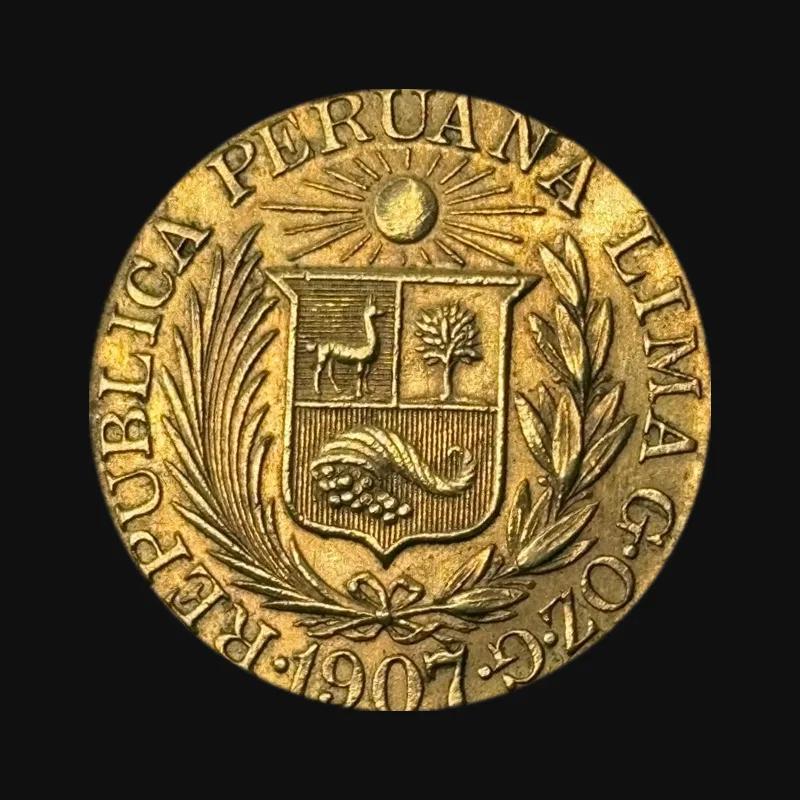
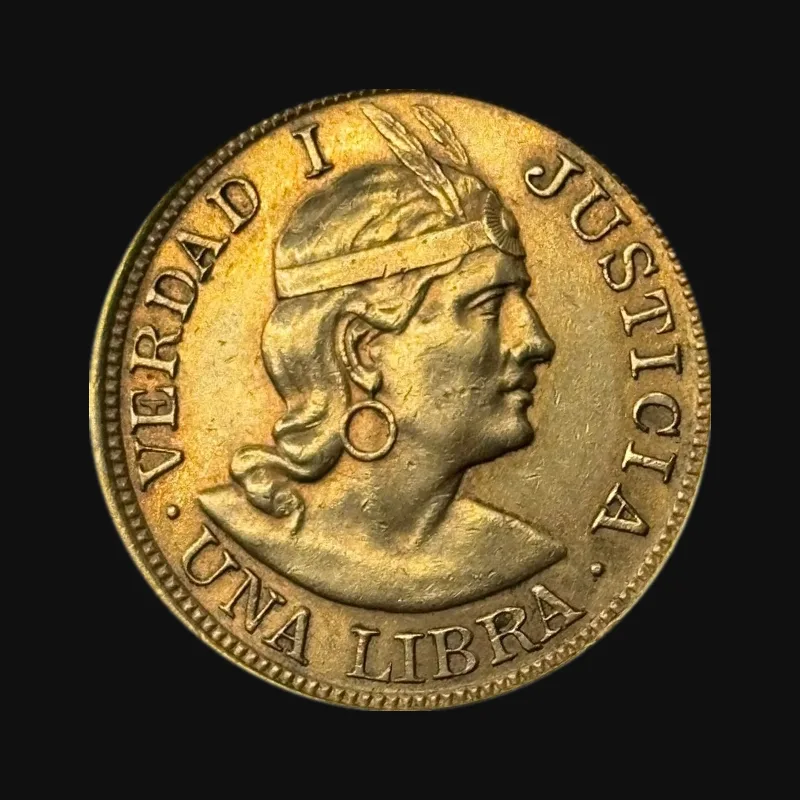
All three denominations share the same designs and the same 22-carat gold. The libra weighs 7.988 g for 22 mm, the half 3.994 g for 19 mm, and the fifth, the smallest, about 1.6 g. On the Inca side the value is written out in words or as a fraction, which settles the question when size alone does not.
After “LIMA”, each coin carries a group of letters: ROZF, GOZF, GOZG, POZG, BBR, ZBR… Catalogues use them to separate several strikes of the same year. Their exact reading sometimes varies between references, as with the 1898 libra.
To avoid mixing it up with a British sovereign of identical weight, just look at the design: no monarch and no Saint George here, but an Inca and the arms of the Republic. Other foreign gold coins are listed in the section foreign coins (in French).
Wear, damage and checks
Wear first reaches the high points of the profile: the cheekbone, the ear and the fringe of the headdress. On the other side, the small details of the shield and the initials fade, sometimes to the point where the variety can no longer be read. A fifth of a libra, being very light, quickly shows knocks and scratches.
Like many gold coins, the libra was often turned into jewellery: soldered loop, mount marks on the edge, polished surface. Such damage lowers the appeal of a less common date. Never rub a coin to make it shine: see the guide cleaning a coin (in French) and the scale of coin grades (in French).
For authenticity, the basic checks remain weight, diameter and sharpness of relief, followed by the match between date and initials. The guide spotting a fake coin (in French) explains the method.